NEXT EVENT

NEXT EVENT: 2021 Rolex Sydney Hobart Yacht Race Double Handed Division

Wednesday, January 20, 2016

Time for some Sigma 36 upgrades

The old 'Rogue' is 33 years young and has had her fair share of new bling since 2009, however she deserves a bit more. So taking advantage of my location and the vast array of boat bits available in the good ole USA, it was time for some upgrades. SO there I was checking out marinas, chandlers and the like and I found this nice Class 40 resting on the hard after the Transat Race at the back of a storage yard in Annapolis...sigh.... she was like a thoroughbred out to pasture.......then I slapped myself back into reality (one day...one day) and continued on my path.


CC-Sprit CS-42 Carbon Bowsprit
So, items to date include; stainless Garhauer Marine footblocks
Garhauer Footblocks.....nice
that are a direct replacements for Lewmar genoa footblocks (so they tell me); a couple of Garhauer Snatch blocks with Quick Release pins so sheets can be quickly installed; a C-SPRIT CS-42 carbon A-Frame bowsprit (eventually a Code 0 and Selden CX Furler);
Snatch Block with Quick Release Pins


Lewmar ST30 spinnaker winches;
 two Lewmar Offshore hatches so that will complete my swap out of all original deck hatches with CAT 1 compliant hatches that can be opened from the outside; and a Ronstan heavy duty 2-Speed Mainsheet System (gotta love eBay!)


Finally invested in a bullet proof Fiorentino Shark Storm Drogue System that I saw for the first time at the 2015 Annapolis Boat Show. Certainly is leagues apart in design (and cost!) from my Aussie designed Burke Sea Brake - I doubted that one could ever hold up in sustained heavy weather - no doubts now!

Shark Drogue - a 10lb mushroom weight attaches to the tail.
Complete system with a 300ft bridle.
An investment in safety is a wise investment.
Check out that hardware!

C-Sprit CS-42 example installed using custom mounts. Comes standard with deck mount or you can mount to the topsides depending on the hull design, anchor configuration and deck clutter. Simply detaches using two Aviation Quick Release Pins.  

Monday, January 18, 2016

2014 Solo Tasman Part 5: Ready about

Ready About!
In Feb 14 with a reshuffle of my day job,  I set off again to conquer the Tasman Sea.......or 'cross the ditch'.
Upper track is weather routing & good for three days.
Lower track is my actual and mirrors weather routing
track except weather came in earlier than forecast.
Boat polars adjusted to compensate..
NZ Currents


There are numerous currents that come into play that influence the natural unhappiness of the seas one encounters mid Tasman.

The second crack at crossing the ditch went like a dream; even had a full day.....and I mean 15+ hours of the day under Assy Spinnaker! Completely uneventful and enjoyable crossing that prepared me well for the race back in April. Had the company of an Albatross for about 5 days. I saw it land on the water next to its female mate and they bobbed along happily. Wasn't long before he took off and again followed me. I wonder why. Maybe the bubble trail of my wake attracts fish to the surface...?
Skipper hard at work.....it does get chilly.
Musto HPX Smock and MPX pants - brilliant!

Training day with storm jib enroute.
Flying the flag for Australia
Waiting for the front to roll on by.

Port Taranaki approaches with Mt Egmont in the clouds

Port Taranaki - time to dry out the old Rogue and wet the insides of the Skipper!

Port Taranaki New Plymouth - Start of the 2014 Solo Tasman Race

2014 Solo Tasman Part 4: What could possibly go wrong Issue #4 - Weather Gods

Issue #4: Weather God.
We drink to him when trade winds blow and we curse him when storms and high winds beat us down.
Finally.....I cleared Customs, Immigration at Newcastle bound for NZ. I headed offshore into 25 knots SE with the forecast reporting the breeze dropping and backing to the East. Yeah right. No backing, no dropping here Mr weather god! I beat NE on starboard for most of the day and night until I could finally tack onto port and head in the general direction of NZ.

Blowing dogs off chains
My weather routing was good for about 3 days out when the Grib wind files became highly inaccurate. So then it was observations, weather fax and experience. On 24 Jan the breeze strengthened and by 25 Jan I was hammered by two Lows (993 and 994hpa) about 100NM apart that continued on their NE track from Antarctica into the Tasman Sea way longer than forecast. 


The low pressure system intensified and it was howling a constant 50 knots with gusts much higher, torrential rain squalls with 2m seas on a 5m+ swell with the top metre blowing off as surf.

I had a full reefed main and flying a rag of a headsail since late afternoon. In hindsight had I known the front was so intense, I would have dropped the main and run under storm jib and Trysail, a lesson learned. Although at that point RW was behaving well and fully under control, plus I was still making great headway at around 8-10 knots (she is a beautiful seaboat). The plan was to ride the back of the Low pressure system as the Low curved back SE toward NZ giving me a lift on the way.

Trysail, Storm Jib and Genoa doing their thing.
At 0100h I was down below when we broached violently.  Not a knockdown, just the opposite. I waited to RW settled before stick my noggin out the hatch into the cauldron outside. It was black. I could see the boom hard against the shroud as the mainsheet had let go.......then I noticed why. The 800kg rated shackle had let go under the load, boom now laid flat against the cap shrouds with the mainsail flogging violently,,,, and then the Auto-pilot said enough....what the ^$%*& and disconnected. Working slowly and methodically I carefully dragged the boom back inside the cockpit and lashed it down as I slowly lowered the halyard all the time trying to protect the mainsail as the battens were now inverted and broken.

After the boom was secured I ran off under jib and dropped the main, lashing all to the rail until morning when I could properly inspect for damage. My problem was we were covering a lot of ground at 10-12 knots and headed back toward Newcastle. After five hours the storm abated enough to inspect for damage. Pics were taken of the boom so I could enlarge on the laptop to do my Non-Destructive Technician (NDI) Tech inspection. I then made the difficult call to return to Newcastle for closer inspection of the boom.
Safe back in Newcastle


I sailed with my trysail, genoa and storm jib and four days later cleared Customs in Newcastle.


Result: Boom sustained damage that required the gooseneck to be reattached; what I though to be a crack in the boom turned out to be deep scaring. The Fridge died as a result of so much water inside the boat that it sloshed up over the fridge electrics. Two sail Battens were broken (now carry top 3 battens spares) and several sail slugs snapped off. I installed two additional bilge pumps port and starboard to deal with future water woes. Lessons learnt - after four days under trysail and storm jib happy to say very pleased with the performance I can get from these sails and will deploy earlier next time so I save my main and genoa. Will purchase a Heavy Weather jib and 110% jib for offshore work and a Code Zero for light winds.
Quick lap of the Tasman Sea - 8 days!

2014 Solo Tasman Part 4: What could possibly go wrong Issue #3 - Keel Joint

Issue #3: The keel joint.
The need to change insurers drove the requirement to have a Survey. Old mate Mike Elton is a tough Surveyor who states it like it is. He has surveyed 'Just Jo' twice and RW twice so he knows both me and the standard of work I am capable off and the boat.


Unscheduled keel removal - mast in.

The Slaughterhouse
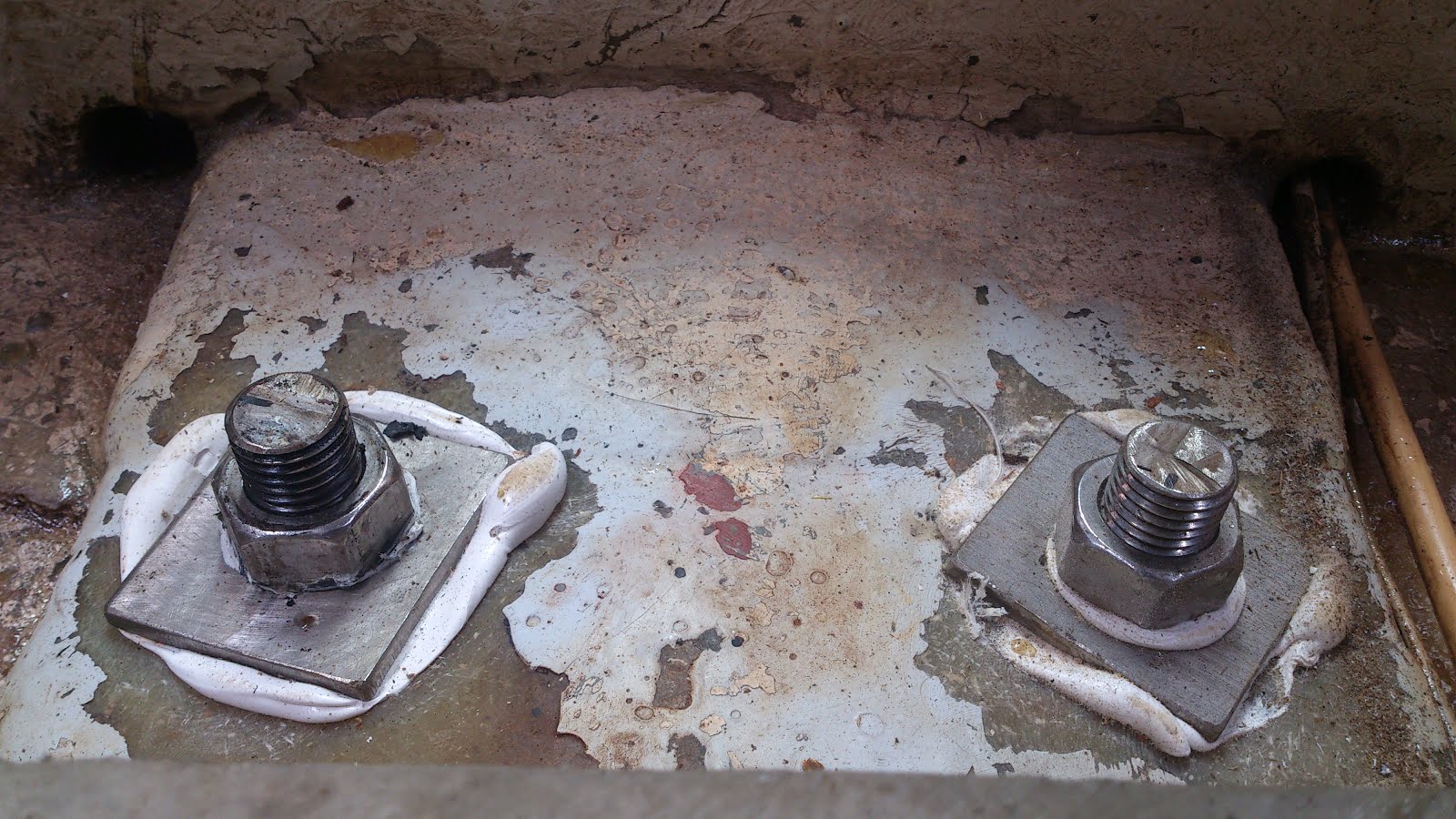
Likely the original 30 year old butyl mastic sealant
So we slip at Mid Coast Boatyard in Newcastle Yacht Club for a quick hang in the slings viewing. Out comes the 10x10" x 6ft  length of lumber to test the keel joint by heaving sideways at the base of the keel to check for movement. I can see water squeezing out of the joint which indicates movement. This keel has likely never been off RW in 30 years, so after a round table with the yard team and Mike we decide to rip the keel off, replace the keel bolts and re-seat the keel in epoxy.
Original backing plates 
The new SS 12mm backing plates
Keel bolts had to be machined from a special High Tensile stainless and once again Mike came through on my behalf and requested his engineer mate to fast track the job. Mike then donated two days of his own time to assist me in dropping and cleaning the keel ready for the new bolts and backing plates. The original backing plates were individual square 3"x3"x 1/4" plates so flexing was assured.

Epoxy pads ensured an even pull across the keel bolts.
Epoxy pads were built to ensure the plates laid flat and the keel bolt pull was in line with the keel. The purpose of the new plates is to spread the load and act as a tie-grid increasing structurally rigidity in the keel box.
My flash new keel bolts good for 30 years!


Joe and his team at Mid Coast knew my agenda for the Solo Tasman. Joe is a gentleman and a former Olympian and Navigator for Sean Langman on his AAPT Open 66 and has raced all over the world. Joe understood the effort and cost (I was self funded) involved just to get to the start line of an international event.
Prepping for splashback
New studs installed and set to length.


Rudder shaft O'Ring replaced
Joe created space in the yard schedule and the team went to work.


To keep costs in check, I took another week off work to help strip the keel and rudder off the boat and prepare for the Mid Coast team to do the pre-installation inspection and install. I needed a second week of after hours work to refit the rudder and tidy up loose ends. I cannot thank them enough.

Result:  Mike and Joe spoke, I listened, we agreed and I paid!

Cast Iron keel with lead forefoot marked by the chalkline.
The first Sigma 36 was quick but tender, so the lead was added for production.


2014 Solo Tasman Part 3: What could possibly go wrong Issue #2 - Insurance

Issue #2: Insurance.
The race start was Apr 14. In late 2013 my UK based insurance company advised that due to a change in international policy, where a company Underwritten by Alliance had a representative in Australia, I had to insure via the Australian based company. In this case I thought simple, go back to Club Marine (previously held insurance with them for about 10 years), present the survey from last year and get Offshore International Bluewater cover for the race. Not so fast he says......need another survey he says......must hold insurance with us for 12 months before Bluewater cover can be issued he says.....you want to race NZ to Australia he says......and so the banter continues. 


Result: In the end, my existing company Fastnet extended my coverage including race cover, to keep my stress levels and temper in check. Fastnet were awesome to deal with and covered me during my solo trip back from Malaysia, across and back to NZ and down to Port Stephens. Its a shame I cannot continue with them.


2014 Solo Tasman Part 2: What could possibly go wrong Issue #1 - Collision at Sea

What could possibly go wrong he said.......well, Mr Murhpy was hard at work on four fronts; collision at sea, insurance, keel joint and weather gods!

Issue #1: Collision at Sea.
In mid 2013, a large abandoned cruising floating footpath (ferro-cement) yacht drags its mooring and collides with the old 'Rogue' on her mooring. I am on board doing some maintenance when a 35-40 knot front rolls on through the mooring field. I stand up watching the weather drinking a coffee from the cosy cabin when suddenly a boat 'appears' where it should not be. I shoot out the hatch topside to look into the driving rain to see the 'footpath' descending beam on at my bow  and dragging her mooring with her. I wait as she slowly gets closer and closer all the while thinking of action plans in my head........first one is don't injure yourself. I wait  for the footpath to ride up my taught mooring line expecting any minute that her barnacle encrusted hull would cut RW free (with my engine in pieces) and we would both be on the beach.

The footpath rode up and up and up and slammed into the pulpit, then with the strength of a thousand steroid enriched Spartans, I pushed as hard as I could using the mooring line as the bow string and managed to slew her sideways down the starboard side. I raced back to get a roaming fender but by the time I returned to the bow she had collided twice more chunking the hull. I ran alongside and managed to intercept every collision so further damage was avoided, then stood and watched as she bounced her way through three trot lines of moorings until she rested on the beach.......on land where all footpaths belong!

The owner of the yacht was deceased so this added a twist to the whole saga, but I eventually recovered my Excess from the Estate 12 months later. Even though RW is a 1983 yacht parts are still available in the UK. Pulpit and stanchions replaced and repaired and the fiberglass returned to a reasonable condition noting the match of gelcoat would be tough.

Result: Insurance came through and Noakes completed the work in Port Stephens with little impact on my preparations for the Solo Tasman.


2014 Solo Tasman Part 1: Preparation

Rutland 913i Wind Generator
 The old 'Rogue' needed to be CAT 1 ready so many hours and dollars were expended to achieve the goal. I started 3 years out to avoid the 'sticker' shock of trying to do all at once. Great idea in theory but you still get some surprises no matter how much you plan....you just need to ensure contingency plans are in order and funded!
Prepped ready for the Survey in Newcastle
Backup power generation is also mandatory. I installed a Rutland 913i Wind Generator system and 40 watt solar panel all running through the Rutland controller. Very quiet system with just a hum that gives you comfort that amps are being generated to cover all my needs without running the engine.

Companionway hatches need to be opened from the interior and exterior and sliding hatches need to be held in either an open or closed position. I installed a beautiful (costly) piece of kit from the UK ensuring the hatch was secure when I left RW locked up in NZ before the race.

Latch operates internally and externally
Electronics required supplementation and upgrading. Raymarine came through with a nice sponsorship offer of a new Evolution Autopilot (AP) and discounts on any additional electonics I required. I had most of what I needed already so built in some additional redundancy and added an i50 Close Hauled wind instrument. In return I drafted technical feedback of the AP performance over the outbound cruise and during the race.
Raymarine EVO Auto Pilot
I married the system to my existing Jefa drive and integrated all with my legacy and Seatalk NG system. Adjustment o the autopilot could be undertaken from the helm p70 control, helm touchscreen plotter (a65), companionway ST60 control, Nav station e7 plotter or even a tablet giving me total flexibility without the need to use a remote.

All was routed through my laptop running Open CPN and SeaPro 3000. I replaced the Ray 101 plotter in the cockpit with a new Raymarine a65 touchscreen installed in a rail pod, starboard of the helm. Not a fan of bright lights in my vision.

a65 Touchscreen in housing
can swivel
e7 Hybrid displays instrument data
An e7 Raymarine at the chart table serves as the Instrument relay centre repeating an array of data including windspeed, direction, depth, heading, drift, course, heel, boatspeed and speed over ground. An AIS package completes the package.

i50 Close Haul, Wind Tridata.
ST60 to be fitted
An Icom HF radio was installed with Weatherfax on the laptop (plus Android App backup) since I had no Satellite comms for grib files - I was racing blind after three days out when the Grib Files lost there accuracy so did my routing..... this is something I will rectify for the 2018 race.

Laptop runs Open CPN and Sea Pro 3000
A hired my Liferaft from Great Circle Liferafts in Brisbane and they did me a great deal due to the nature of the event and the need for an extended hire. They even threw in a SPOT tracker so home base could track my movements!
Great Circle Liferaft and Orange Spot Tracker.
C.A.R.D Radar Detector antenna mounted on starboard rail.